By Jim Peifer
California’s water challenges are becoming more interconnected, more unpredictable, and harder to solve through traditional approaches.
This year provided another reminder. After winter storms delivered significant precipitation across parts of the state, record-hot March temperatures rapidly erased much of the Sierra snowpack weeks ahead of schedule. Reservoirs filled early, runoff arrived sooner than expected, and water managers were again forced to navigate the growing tension between flood protection, water supply reliability, ecosystem health, and increasingly volatile weather patterns.
But the larger lesson is not simply that climate change is accelerating. It is that climate impacts no longer fit neatly within agency boundaries, individual river systems, or single-focus solutions.
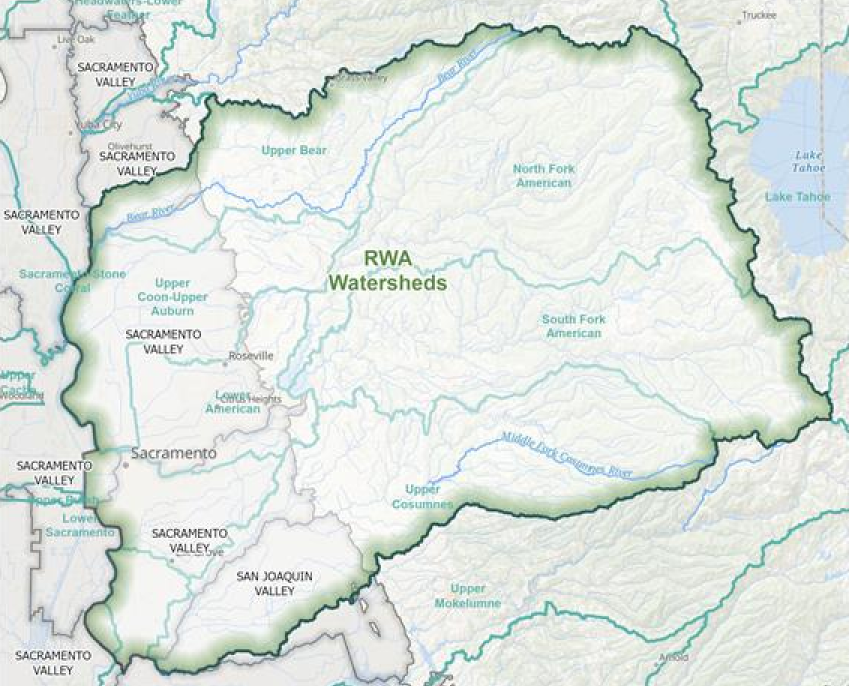
That reality drove development of a new Resilience Plan for the American, Bear, and Cosumnes watersheds—one of California’s first efforts to approach climate adaptation across interconnected watershed systems at the scale they actually function.
Funded by the California Department of Water Resources and developed in partnership by the Regional Water Authority, technical experts, public agencies, community organizations, and Tribal partners, the plan examines how climate risks are reshaping the broader watershed system that supports the Sacramento region. That includes forests, rivers, reservoirs, groundwater basins, flood systems, ecosystems, infrastructure, and communities across the interconnected American, Bear, and Cosumnes watersheds.
These watersheds support more than 2.2 million people, account for roughly 8 percent of California’s developed water use, and contribute important flows to the Sacramento-San Joaquin Delta.
The plan’s vulnerability analysis confirms what many water managers have already begun experiencing firsthand: shrinking snowpack, earlier runoff, more intense storms, increased wildfire risk, hotter temperatures, and growing pressure on both water systems and vulnerable communities. By mid-century, the region could see snowpack declining by roughly 60 percent, snowmelt occurring two to four weeks earlier, and significantly greater flood and heat risks.
But documenting those risks is only part of the story. The more important question is, what do we do with that information?
For the Sacramento region, the answer is increasingly clear: climate adaptation must expand beyond individual agencies and even traditional regional boundaries to a mega-watershed-scale approach that coordinates water management, flood protection, ecosystem health, forest resilience, and community preparedness across interconnected systems.
That represents an important shift in how water management has traditionally operated in California. Historically, agencies often planned around individual systems, individual responsibilities, or specific projects. Climate change is forcing regions to think more holistically because the impacts themselves are interconnected.
Forest conditions affect water quality and reservoir operations. Flood management decisions influence groundwater recharge opportunities. Reservoir operations affect fisheries and river temperatures. Extreme heat, wildfire smoke, and flooding disproportionately affect vulnerable communities with the fewest resources to respond.
The Watersheds Resilience Plan attempts to address those connections directly. The plan identifies 19 adaptation strategies and 119 potential actions designed to strengthen long-term resilience across the watersheds. Perhaps most importantly, it establishes a structure for evaluating priorities, aligning investments, and helping agencies move more strategically as implementation opportunities emerge.
That kind of coordination may ultimately become one of the region’s most important climate adaptation tools.
The value of the Watersheds Resilience Plan is not simply that it identifies climate risks. It gives the region a way to evaluate potential solutions and determine where limited resources can have the greatest impact.
Not every project can be funded, and not every opportunity can be pursued at once. The plan provides a common framework for assessing projects based on their ability to improve resilience, reduce risk, support vulnerable communities, and deliver benefits across multiple parts of the watershed system. It helps agencies move beyond reacting to individual challenges and toward making coordinated, long-term investment decisions.
At a time when climate pressures are increasing and resources are constrained, that kind of prioritization matters. The region now has a roadmap for identifying the projects that can provide the greatest benefit and a process for advancing them as funding and partnership opportunities emerge.
Plans alone will not create resilience. Implementation will. And the Sacramento region now has something it did not have before: a shared understanding of the risks, a portfolio of potential strategies, and a framework for turning ideas into action.
The challenge now is to put that framework to work.
You can learn more and read the Watersheds Resilience Plan at https://rwawatershedsresilience.com/plan/.