By Michelle Banonis, RWA Manager of Strategic Affairs
The Sacramento region is putting state funding to work. Today, the Sacramento Suburban Water District commissioned four new groundwater wells. And, last year, Citrus Heights Water District made significant construction progress on two aquifer storage and recovery (ASR) wells, a type of well that can both inject drinking water underground for storage in wet years and recover it for use in dry years.
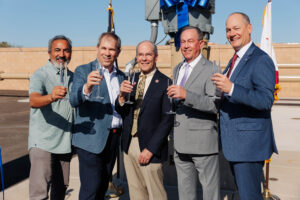
Speakers at SSWD’s groundwater well commissioning event celebrate with a glass of water from the new wells. Pictured from left: U.S. Representative Ami Bera, Regional Water Authority Executive Director Jim Peifer, California State Senator Roger Niello, SSWD General Manager Dan York, and Sacramento County Supervisor Rich Desmond.
These are among more than a dozen groundwater projects supported by $55 million in state funding—part of a landmark partnership between the Department of Water Resources (DWR) and the Regional Water Authority (RWA) announced in 2023.
The state’s funding infusion is enabling the construction of up to 21 new or improved wells, pumps, interconnections, and storage facilities across the region. These projects are designed to expand the Sacramento Regional Water Bank, giving local agencies the ability to recharge aquifers during wet years and rely on groundwater during dry years.
The investment is not just about infrastructure—it is directly connected to the health of the American River. Local agencies developed a commitment to provide 30,000 acre-feet of water to the lower American River in dry and critical years from the Water Bank. These flows will provide needed in-river habitat for salmon and steelhead while also supporting beneficial uses of the Delta.
These flows will augment commitments made for the Healthy Rivers and Landscapes Program (HRLP) in conjunction with additional water being provided from upstream tributaries and improved habitat in the lower American River.
HRLP establishes the policy framework for improving conditions in rivers and the Delta while maintaining water supply reliability. In the American River region, the Water Bank provides the operational backbone to meet those commitments by shifting to groundwater in dry periods and therefore leaving more surface water in the river when fish need it most.
The new and upgraded infrastructure funded by the state—wells, pumps, and treatment facilities—makes these commitments achievable, creating the flexibility needed to store water underground in wet times and deliver it during dry times.
Progress Across the Region
Several projects are already in operation or advancing quickly as a result of this funding:
- Sacramento Suburban Water District completed four wells, including one with ASR capability, together adding up to 7,500 gallons per minute of supply capacity.
- Sacramento County Water Agency is implementing well and treatment plant upgrades in Elk Grove to provide up to 6,000 gallons per minute of additional capacity.
- City of Sacramento replaced a 70-year-old well and modernized other existing facilities, bringing about 4,900 gallons per minute online while reducing pressure on river diversions in dry years.
- City of Roseville is constructing two ASR wells, expanding its system to nine wells with a combined 4,400 gallons per minute of extraction capacity and an estimated 2,200 gallons per minute of recharge capability.
- Carmichael Water District is replacing two wells with ASR capacity, adding up to 3,000 gallons per minute of supply and 1,500 gallons per minute of recharge capacity.
- Citrus Heights Water District is constructing two ASR wells, adding 2,700 gallons per minute of supply capacity and up to 1,350 gallons per minute of recharge capacity.
These projects were included in agency capital improvement plans but faced long timelines and uncertainty related to their implementation without state funding. Obligated state dollars are accelerating their completion and aligning them with flow commitments.
For water managers, the implementation of these projects offers proof of concept: State funding is already producing measurable outcomes. The projects provide dual benefits—strengthening local reliability while contributing to improved conditions on the lower American River and supporting Delta objectives. They also demonstrate the catalytic role of state funding, accelerating projects that might otherwise have taken years to complete. This progress emphasizes the importance of state-local partnerships.
Each project expands the Water Bank’s capacity to deliver flows alone or under HRLP, improves resilience to climate-driven variability, and contributes to healthier river habitat.
One well at a time, the Sacramento region is showing how state investment, local initiative, and shared commitment to healthy rivers and reliable supplies are delivering real progress for the lower American River, the Delta, and California’s water future.
Michelle Banonis is the Manager of Strategic Affairs for the Regional Water Authority, a joint powers authority representing nearly two dozen water providers serving 2.2 million people in the greater Sacramento region. Formed in 2001, its primary mission is to help its members protect and enhance the reliability, availability, affordability, and quality of water resources. Learn more at rwah2o.org. Learn more about the Sacramento Regional Water Bank at sacwaterbank.com.